


A Living Tradition Rooted in History
Native American pottery is one of the most enduring and expressive forms of Indigenous art in North America. From utilitarian vessels to ceremonial works of art, these handcrafted pieces reflect generations of cultural identity, spiritual symbolism, and skilled craftsmanship.
The history of Native American pottery spans millennia. While many associate the practice with Southwestern tribes, particularly Pueblo peoples, archaeological evidence shows that pottery’s roots go back as far as 4000 BCE in areas like Georgia, Florida, and Missouri. As tribes migrated and traded, techniques and designs were shared, enriching the diversity of Indigenous pottery styles across the continent.
Ancient Southwestern Pottery Traditions
While many people commonly associate pottery from the southwestern United States with the widely recognized Acoma Pueblo or the People of Zuni, the reality is that pottery has been central to Pueblo life for centuries. To fully appreciate the region’s pottery legacy, it’s essential to understand how far back Pueblo pottery traditions date and how ancient practices have shaped modern styles.
Mogollon, Hohokam, and Early Innovation
The ancient Southwest was home to some of the earliest pottery traditions. The Mogollon peoples inhabited a region spanning southeastern Arizona, southwestern New Mexico, and extending into northern Mexico and Texas. By the mid-3rd century CE, they developed brown ware pottery, which was simple in form but foundational in technique, with methods that endured for centuries. The Hohokam, who lived in present-day south-central Arizona and as far south as northern Mexico, were among the first to decorate pottery with painted designs. By the 5th century CE, they were applying red iron-oxide pigments in repeating patterns, introducing one of the earliest artistic innovations in the region.
Kayenta and Polychrome Emergence
Between 1100 and 1200 CE, the Kayenta Region of northern Arizona experienced a shift in pottery styles as black-on-red ware came into fashion. Prior to this, black-on-white pottery had dominated. However, with widespread migration and the decline of major cultural hubs like Chaco and Mesa Verde, new influences emerged.
Tribes such as the Salado, Sinagua, and Mogollon played key roles in this stylistic transition. Some of the earliest known examples of polychrome design originated during this era, forming the basis for the widespread revival of polychrome pottery in the 19th century.
Hopi and the Revival of Traditional Art
In what is now modern-day Arizona, the Hopi people continue to steward some of the oldest continually occupied lands in North America. One notable historic site is Sikyátki, a village active between the 14th and 17th centuries, where well-preserved examples of Hopi Pueblo pottery have been uncovered. These pieces are widely admired for their beautiful polychrome style and served as inspiration for the renowned Hopi artist Nampeyo. Her work played a pivotal role in reviving traditional Hopi techniques and decorative motifs that continue to influence artists today.
Pottery Techniques Across Tribes
With regional traditions established, let’s explore how clay is transformed into pottery through craftsmanship rooted in both environment and technique.
Native American pottery-making was shaped by both local environments and tribal traditions. Artisans began by gathering clay from their surrounding land, which they mixed with water and organic or mineral tempers such as crushed rock, charcoal, or plant fibers. This mixture prevented the clay from shrinking or cracking during firing. The clay was then thoroughly kneaded to evenly distribute the temper and eliminate air bubbles, which could cause explosions in the firing process.
Shaping by Hand: Coils, Slabs, and Pinching
Two primary shaping methods emerged: the coil technique, where long strands of clay were layered in a spiral and smoothed together, and the slab technique, which used flat panels joined by scoring.
Some artisans also used pinching techniques, molding the clay by hand by pinching it to stretch and shape it. The paddle and anvil method involved forming the clay between a wooden paddle and a stone anvil, creating symmetrical, thin-walled vessels ideal for everyday use.
Polishing, Painting, and Firing
Once formed, the surface was polished and painted using natural mineral or plant-based pigments. Brushes made from yucca leaves allowed for detailed decoration. The vessels were then fired in open pits covered in wood, dried grass, or manure. This process required careful heat control over several hours to ensure even hardening and to prevent cracking.
Regional Styles and Tribal Signatures
Each tribe developed distinctive pottery styles shaped by their local environments, daily needs, and spiritual beliefs.
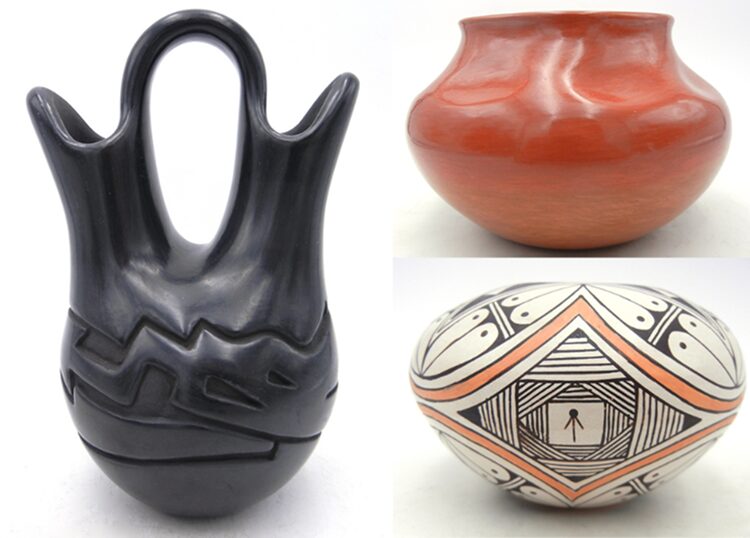
- Acoma Pueblo: Recognized for light-colored clay and geometric polychrome patterns in black or red. These intricate designs often involve fine lines and complex shapes, reflecting the potter’s precision and artistic flair.
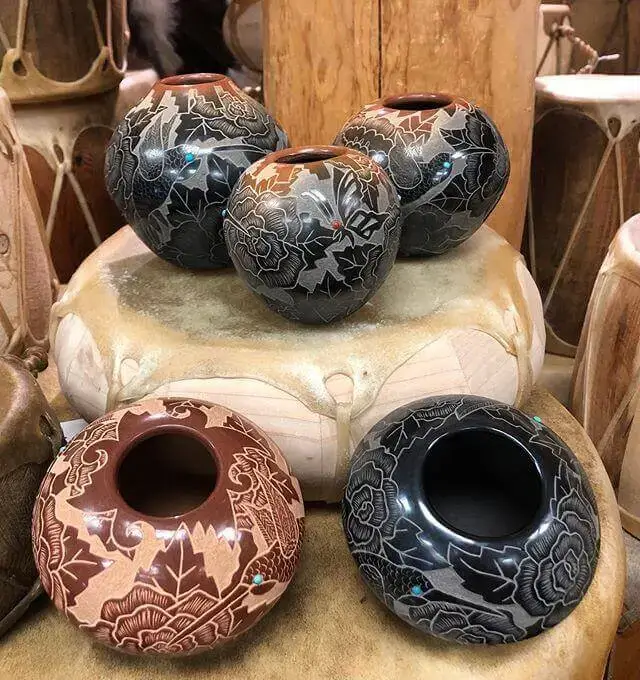
- Santa Clara / San Ildefonso: Known for blackware pottery made using a specialized reduction firing technique. These pieces often feature highly polished surfaces and carved decorative elements.
- Hopi: Noted for vibrant polychrome pottery painted with natural mineral and plant-based pigments. Designs frequently include birds, animals, and plant motifs, and the vessels are prized for their symmetrical shapes and smooth finishes.
- Navajo: Typically unpainted and earth-toned, Navajo pottery often features a pine pitch glaze and no décor or pattern. Sharing traditional imagery and symbolism is a practice discouraged by the elders. These pieces are fired using traditional methods in outdoor kilns, giving them a distinct rustic texture.
Across tribes, pottery designs frequently incorporate symbolic imagery, such as deer, birds, bears, water patterns, and celestial symbols. Some styles also use etching techniques, where painted air-dried clay is later fired to set the design.
Native American pottery is unique to North America, and Pueblo pottery, in particular, holds deep ties to the Southwest. Each piece reflects centuries-old techniques mastered over generations by individual artists. Its rarity lends to its inherent value, and its authenticity ensures the magic of Southwest art is fully preserved. But when a piece is fake, that magic and its cultural significance are lost. Fortunately, there are ways to recognize authenticity, even for new collectors.
Identifying Authentic Native American Pottery
Legal Protections and Labeling
Federal law provides important protections for buyers of Native American pottery. Under the Indian Arts and Crafts Act of 1990, only art made after 1935 by a member of a state—or federally recognized tribe—may be accurately marketed as “Native American” or “Indian.” This gives consumers confidence when purchasing. Be wary of terms like “Indian-style,” which are often used for mass-produced imitations created by non-Native artists.
Visual Signs of Authenticity
While some Native artists work with greenware, traditional Pueblo pottery is hand-coiled, a process that leaves subtle signs like finger marks inside the vessel. These details reflect the handmade nature of authentic pieces, which are often signed by the artist. Most artists sign or etch their names into the bottom, sometimes adding their Pueblo affiliation. These signatures are known as hallmarks. If a piece is stamped or completely unsigned, it may be a reproduction rather than a genuine work of Native artistry.
Buy from Trusted Sources
Authentic Native American pottery should be purchased from reputable dealers who maintain direct relationships with the artists. Always ask about the artist, their Pueblo affiliation, and how the piece was made. Reputable dealers will provide transparent histories and demonstrate knowledge of Indigenous pottery traditions.
You can do some research by reviewing the dealer’s website, checking how long they’ve been established, and determining whether they are active in the Native art community. Events like the Santa Fe Indian Market or local feast days also offer opportunities to meet artists directly and buy pieces firsthand.
The Value of Authentic Pottery
Each piece of authentic Native American pottery is one-of-a-kind, a direct expression of an artist’s heritage, skill, and creativity. This craftsmanship, passed down through generations, commands a price that reflects its cultural and artistic significance. If a deal on a piece seems too good to be true, it often is, because imitation pottery lacks both the artistry and the authenticity of true Indigenous work.
Pricing can vary depending on the size, complexity, the artist’s reputation, and whether the artist is living or deceased. But one thing remains constant: authentic Native American pottery is an investment. With proper care, these pieces can retain their beauty for a lifetime and often appreciate in value.
Why Authenticity and Preservation Matter
Authentic Native American pottery is more than decor; it’s a living heirloom of ancestral wisdom, artistry, and cultural identity. Fakes may look similar, but they don’t offer the same benefits of genuine craftsmanship. By purchasing authentic work, buyers directly support Pueblo artists, many of whom rely on pottery income to support their families, and help preserve centuries-old traditions passed down through oral teachings and apprenticeship.
Preserving these pottery traditions connects us to the past and ensures their survival into future generations. Platforms like tribal art markets, museums, and galleries actively promote these crafts and educate the public. Palms Trading Company is committed to this mission, offering a curated selection from renowned Native potters and fostering a deeper appreciation of their origins, techniques, and styles. Choosing authentic pottery opens a window into Indigenous culture and identity, making each piece a meaningful and treasured addition to your home.
Organizations, galleries, and ethical trading companies like Palms Trading help raise awareness and ensure fair trade with Indigenous artisans.
Add to Your Collection With Confidence
At Palms Trading Company, we provide authentic Native American pottery sourced directly from indigenous artists. Our knowledgeable staff is here to help you understand each piece’s origin, the history of Native American pottery, and its cultural context. Whether you’re a new collector or a seasoned enthusiast, our gallery offers timeless art for any space. Contact or email us today to find the piece that speaks to you; each one tells a story shaped by tradition.