


Origins of the Bolo Tie
The history of Native American bolo ties begins with the bolo tie itself: a classic Western accessory, recognizable by its two decorative ends connected by a thin cord. Many attribute its origins to the 1930s, when Native American tribal silversmiths in Arizona and New Mexico began crafting an alternative to the traditional necktie, suited to the more relaxed lifestyle of the Southwest.
One early form of this accessory involved Native American men from Zuni, Navajo, and Hopi tribes tying bandanas with shell or string around their necks, which later evolved into what we now know as the bolo tie. Another frequently cited origin story involves Manny Goodman, a New Mexico craft store owner in the 1930s, who observed Native American people wearing bandanas clasped with metal. This common sight, according to some historians, inspired the modern bolo tie.
Though the cultural roots lie in Native American communities, Victor Cedarstaff of Wickenburg, Arizona, is often credited as the inventor of the bolo tie. Legend has it that one windy day in Arizona, his hat blew off while horseback riding. He retrieved it, wore it backward with its silver band around his neck, and his companion remarked how it resembled a tie. Inspired, Cedarstaff filed a patent in 1954, officially granted in 1959, for a “Slide For a Necktie.”
However, despite Cedarstaff’s self-promotion, many historians emphasize that he was not the original creator. Multiple claims have been made throughout history, but most agree that Native American artisans were the true innovators of this now-iconic style.
Cultural Significance and Craftsmanship
Because of its popularity among southwesterners, especially Native Americans, some people are hesitant to wear bolo ties due to fears of cultural appropriation. This concern is valid, given the frequent exploitation of Native American art by outside communities for profit. However, bolo ties differ in that they do not have religious or ceremonial roots, unlike many Native American art forms. They do, however, hold cultural significance, and when worn respectfully and sourced authentically, they are generally seen as an appropriate way to honor indigenous craftsmanship.
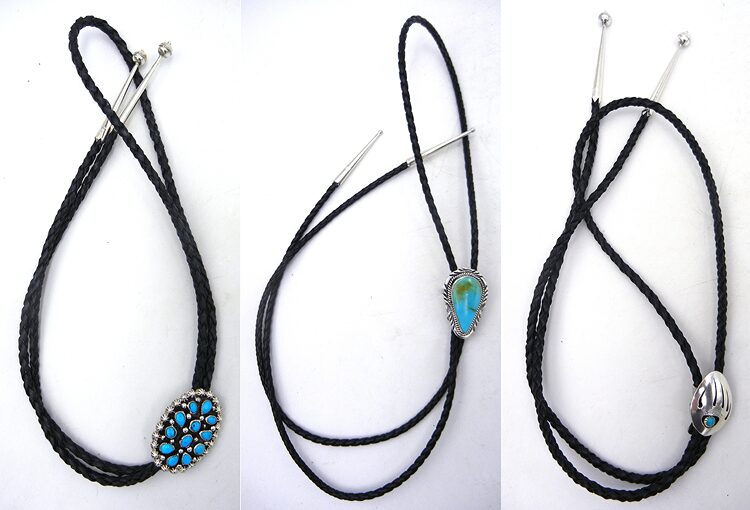
The bolo tie, also known as a bola tie or boot-lace tie, is a unique combination of a necklace and a necktie. Most often made from braided leather, it’s folded in half and clasped with a part known as a slide. The artistry is expressed through the braided leather cords and metal aiguillettes (tips), but the slide is what truly draws attention. Typically crafted from sterling silver and turquoise, the slide often features culturally significant symbols, either hand-stamped or rendered in intricate inlay. Together, these elements reflect the deep indigenous craftsmanship embedded in every bolo tie.
Over time, Native American artists, especially Navajo, Hopi, and Zuni, popularized bolo ties with their distinctive styles. Their hallmark designs and use of semi-precious stones are what made the bolo tie iconic.
The Bolo Tie’s Rise to Popularity
Throughout the decades, the bolo tie has gone by many names: bola tie, cowboy tie, gaucho tie, or bootlace tie, and it has seen numerous waves of popularity. Its first widespread appeal began in the 1940s among ranchers and cowboys, followed by a surge in the 1960s and 70s.
In 1971, the bolo tie was even deemed a business staple in some circles, and its status as a cultural fashion statement was cemented during the 1980s rockabilly revival. By the 1990s, the bolo tie had captured global attention, especially in East Asia. Countries like Japan, China, and South Korea embraced the accessory, often incorporating exotic woods, jade, and dragon motifs into the design, elevating the bolo tie into a luxurious fashion piece.
Contemporary Designs and Styles
Bolo ties have continued evolving into the 21st century. In the 2000s, artists began incorporating more intricate beading and symbolic motifs. Today, bolo ties come in a wide array of styles, ranging from traditional Native American craftsmanship to contemporary interpretations like steampunk and sleek-modern aesthetics.
Whether worn for fashion or heritage, bolo ties carry with them the timelessness of the American spirit and Native American ancestry. They transcend gender, age, and culture, representing more than just an accessory.
Customization Options
Despite their seemingly simple structure, bolo ties offer several custom design options that allow wearers to express personal style. Let’s dive into some of those options.
Cord Length
Most bolo ties come in two lengths: standard (38-40 inches) and extra-long (40-42 inches), depending on your preference and outfit.
Cord Color
Traditionally, cords were made from black or brown leather. Today, bolo ties come in a variety of colors and materials, making them easy to coordinate with both formal and casual attire.
Slides and Tips
Slides are often made from sterling silver and decorated with turquoise or other semi-precious stones. Navajo artists often feature turquoise prominently, while Zuni and Hopi artists may use needlepoint or overlay techniques. Some modern designs use gold, wood, resins, or stones, and offer functional variations like gripping clasps instead of sliding loops.
Bolo Tie Necklaces
Jewelry designers have reimagined bolo ties into necklace forms, often worn by women. These bolo tie necklaces maintain the adjustable slide and classic structure but offer a more elegant appearance, blending tradition with modern fashion.
How To Wear and Maintain a Bolo Tie
Bolo ties are incredibly versatile. They can be worn with collared shirts as a replacement for traditional ties or worn loosely like a necklace. Whether your outfit is formal or casual, wearing a bolo tie honors the craftsmanship and culture of the Southwest.
To care for your bolo tie, it’s important to periodically inspect the stones and slide mechanism. Over time, materials may loosen or fade, and a skilled artisan or jewelry polisher can restore their original beauty.
Checking for hallmarks, such as stamps on the slide or aiguillettes, can help you determine the tie’s origin, material, and value. These markings often indicate the artist and materials used.
Where To Find Authentic Bolo Ties
If you’re inspired by the rich history of Native American bolo ties and ready to bring home a meaningful piece of indigenous artistry, Palms Trading Company is your trusted source. We proudly offer a curated selection of authentic, handcrafted bolo ties from Navajo, Zuni, and Hopi artists, each piece reflecting generations of cultural tradition and craftsmanship.
We make it easy to find a bolo tie that matches your personal style. Shop online today or take advantage of our free personal shopper service, where our knowledgeable team can help you find the perfect piece based on your taste and budget.
Have questions? Contact us anytime or give us a call to connect with one of our in-store experts. At Palms Trading Company, every bolo tie is more than an accessory; it’s a piece of history you can wear with pride!