


When discussing Hopi tribe history, many think of the tribe’s significant influence on Native American culture and art. The Hopi, known as Hopituh Shi-nu-mu, or “The Peaceful People,” have a rich history as one of the oldest Native American tribes in North America. They have lived for thousands of years in what is now northeastern Arizona, part of the Four Corners region where Arizona, Colorado, New Mexico, and Utah meet. Today, the Hopi Reservation spans more than one and a half million acres and is home to a rich cultural and artistic tradition, including expert jewelry crafting, carving, pottery making, and painting. Deep spiritual beliefs, artistic mastery, and a profound connection to their ancestral lands continue to shape Hopi identity and influence Native American art and heritage.
Ancient Origins and Historical Legacy
Ancestral Roots
The Hopi are believed to be descendants of the Anasazi People, an ancient civilization of the Southwest, with distant cultural ties to the Aztecs of Mexico. While the geography and environment of the region are commonly thought to be particularly challenging to live in, the survival of the Anasazi and their descendants can partially be attributed to the complex ceremonial calendar that helped them thrive in a region where water was scarce.
The Hopi people have lived in the same location for thousands of years, cultivating a strong connection to their land, which is central to their survival and spiritual life.
Mythological Creation
The Hopi people believe that they were created by their ancestors, the Kachina spirits, who came from the underworld to the earth’s surface. According to Hopi legend, the Kachina spirits helped the Hopi people survive and thrive in the harsh desert climate of northeastern Arizona. These spirits are still central to Hopi spirituality and art.
Pueblo Revolt and Alliances
After colonization brought on intense conflict and marginalization in the 16th and 17th centuries, the Hopi People participated in the Pueblo Revolt in 1680. This conflict against Spanish colonists involved all Hopi Pueblos pushing the Spanish out of their occupied territory to El Paso, Texas. Around this time, the Hopi People from Walpi, the First Mesa village, allied with the Tewa people of the Rio Grande to help protect the communities. This, in turn, led to the resettlement of the Tewa People to the First Mesa and is the origin of the Hopi-Tewa community, which continues to reside in the First Mesa to this day and also speaks their unique language.
Government Relations and Forced Assimilation
It wasn’t until 1849 that the U.S. government appointed a formal Indian Affairs representative. The first official meeting with the Hopi took place in 1850 in Santa Fe, addressing rising tensions with the Navajo. As a result, Fort Defiance was established in 1851 to manage the conflict.
In 1882, President Chester Arthur signed an executive order formally establishing the Hopi Reservation. Five years later, a boarding school was built in Keams Canyon to assimilate Hopi children into European-American culture. Students were punished for speaking their language or practicing traditional customs. Many Hopi parents resisted sending their children, and in 1890, federal troops were dispatched to enforce attendance under threat of arrest.
Throughout the 1900s, the U.S. government expanded its presence on Native reservations by building schools, missions, and clinics. Each reservation was also required to develop its own legal and political systems. It wasn’t until 1924 that Native Americans were granted U.S. citizenship and the right to vote.
Today, over 18,000 Hopi people continue to reside in the United States. Like many Native American tribes, the Hopi have a long and complex relationship with the U.S. government and have continually fought to preserve their rights, land, and sovereignty.
Despite the significant challenges and pressures of forced assimilation, the Hopi people have preserved a vibrant spiritual tradition and deep cultural values that continue to guide their way of life today.
Hopi Culture and Spiritual Worldview
Peace, balance, and harmony are core values in Hopi life. Their worldview emphasizes respect for nature and spiritual forces, maintained through an intricate ceremonial calendar.
One of the most essential aspects of Hopi culture is the tribe’s language. Despite the Hopi people descending from the ancient Aztecs, their language closely resembles Nahuatl. Like in many indigenous tribes, the language is beginning to be spoken less by younger generations, but efforts are being made to preserve it.
Another important aspect of Hopi culture is their spiritual beliefs. Central to Hopi spirituality are the Kachina spirits, who are believed to influence all aspects of life, from weather and fertility to successful harvests. These spirits are honored in rituals such as masked dances and intricate carvings. One significant ceremony, Soyal, marks the winter solstice and welcomes the sun’s return, inviting blessings and seasonal renewal. During these ceremonies, Hopi men wear beautifully crafted masks to represent the Kachina spirits. Humility and reverence for all living beings are deeply embedded in the Hopi spiritual tradition.
Hopi Artistic Traditions
Kachina Doll Carving
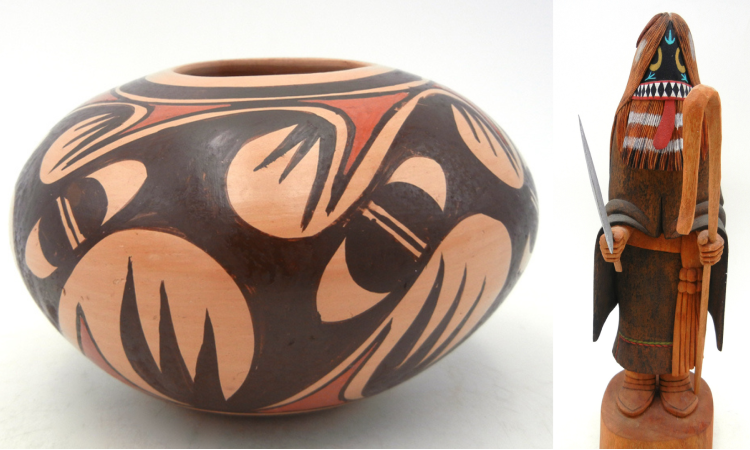
Historically used to educate children about the different Kachina spirits, Kachina dolls are carved from cottonwood root, a water-seeking tree symbolizing life and sustenance. More than 200 different Kachinas are represented in doll form, which are gifted during significant milestones.
Hopi Pottery and Techniques
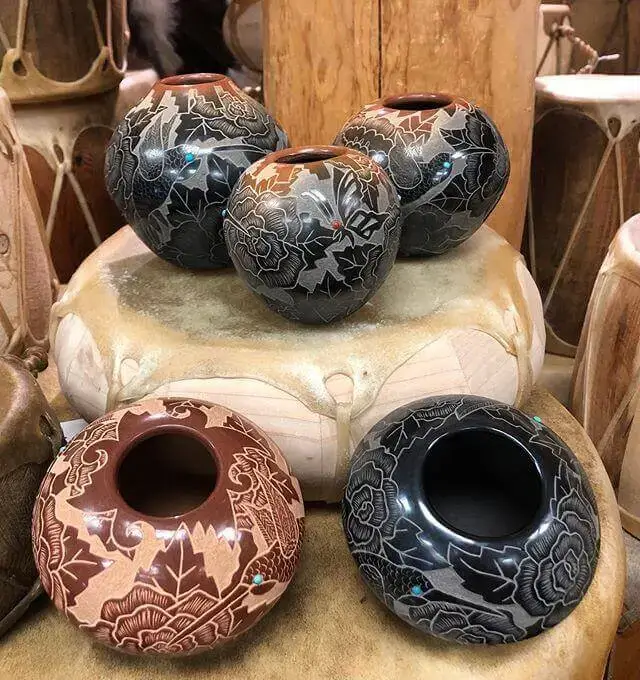
One of the most renowned expressions of Hopi artistry is Hopi Pueblo pottery, which has been a vital part of the tribe’s cultural heritage for thousands of years. Handmade using ancestral techniques, Hopi pottery reflects a deep connection to the land and spiritual symbolism.
The pottery-making process includes several traditional steps:
- Gathering Clay: Natural clay is collected from the local environment.
- Preparing the Clay: The clay is ground finely and mixed with potshards (broken pieces of old pottery) to strengthen the mixture.
- Forming the Vessel: Artisans add water and use the coiling method—rolling long ropes of clay and layering them to build the pot’s shape.
- Smoothing the Surface: The coils are carefully smoothed using tools such as gourds or pieces of wood.
- Drying: The pot is left to air dry thoroughly before painting.
- Painting: A slip made from colored clay is applied, stabilizing the surface. Using fine yucca brushes, artists paint intricate designs inspired by nature, geometry, and spirituality.
- Firing: Finally, the pottery is fired outdoors in a traditional open fire, completing the process.
A pivotal moment in the revitalization of Hopi pottery came in 1895, when an excavation at the ancient village of Sityatki uncovered centuries-old pottery pieces. These discoveries inspired a new generation of artists, including Nampeyo, who reintroduced traditional polychrome designs and helped blend ancestral forms with evolving artistic expression.
Today, Hopi pottery remains highly prized by collectors and has been showcased in galleries and museums around the world for its beauty, craftsmanship, and cultural legacy.
Jewelry, Textiles, and Baskets
In addition to pottery and Kachina dolls, the Hopi are skilled artisans of silver jewelry, basketry, and textiles. Their overlay jewelry technique, in particular, is distinctive for its precision and intricately layered symbolism.
The artistry of the Hopi people is inseparable from their daily lives and environment. Their architecture, farming techniques, and community structures reflect a profound harmony with the natural world.
Traditional Life: Architecture and Agriculture
The Hopi traditionally live in adobe pueblos, multi-story homes built from clay, straw, and water. Hopi villages are commonly found atop a mesa, an isolated tableland or flat-topped hill with three steep sides around it. These traditional villages, called pueblos, were situated atop these characteristic mesas. This community was established and continues to be located on the Third Mesa in what is now the Hopi Reservation. The adobe structures reflect communal living, with upper levels accessed by ladders. Each adobe space was home to one family, while an entire adobe house could accommodate a whole clan.
Agriculture has long been central to Hopi life. The Hopi developed innovative farming techniques suited to their arid environment, including dry farming of corn, beans, squash, and melons. They also used terraced fields and irrigation systems to conserve water and sustain crops. Through trade with neighboring tribes, the Hopi acquired essential goods they couldn’t produce locally, such as cotton for clothing.
Tourism and Cultural Preservation
In the late 1800s, the arrival of the Santa Fe Railway brought tourists to Arizona, sparking widespread interest in Hopi culture. Capitalizing on this, the Fred Harvey Company opened the Hopi House in 1905 on the South Rim of the Grand Canyon. Built in traditional Pueblo style, it employed Hopi artisans, dancers, and guides to share their culture with visitors. The Hopi House remains a historic site within Grand Canyon National Park today.
Hopi Identity and Modern Life
The Hopi remain a matrilineal society, where children inherit clan identity through their mother. However, infants receive their names from their father’s clan 12 days after birth, and may receive additional names throughout their lives, each carrying cultural and familial meaning.
Today, Hopi people continue to live on their ancestral land, with about 18,000 tribal members in the U.S., sustaining their community through natural resources, artisan goods, and tourism. In addition to tourism and the sale of traditional arts, the Hopi economy is also supported by natural resource development, including coal mining and micro-farming. Artisan-made jewelry, pottery, and Kachina dolls remain vital sources of income for many Hopi families.
Explore the rich heritage and artistry of the Hopi People by discovering authentic, handcrafted pieces that embody centuries of tradition and cultural pride.
Connect with Authentic Hopi Art at Palms Trading Company
At Palms Trading Company, we proudly offer an exceptional selection of authentic Hopi Pueblo pottery, Kachina dolls, silver jewelry, and handcrafted pottery – each piece deeply rooted in the rich cultural traditions of the Hopi tribe’s history. Our collection is sourced directly from Native American artisans, ensuring authenticity and supporting the artists who carry on these time-honored practices.
Whether you’re seeking a meaningful gift or looking to add a unique piece to your collection, our team is here to help. Contact or email us directly for guidance.Let us help you find a piece that connects you to the spirit, artistry, and enduring legacy of the Hopi People.